Tempera Painting

Tempera Painting

In Tempera egg yolk and vinegar is mixed with oil colors and painted on dry plaster. It is paint made by binding pigment in an egg medium.
In the early days egg yolk and hand ground dry powdered pigments were mixed together to create tempera. Sometimes ther materials such as honey, water, milk (in the form of casein) and a variety of plant gums were added to this concoction. With the invention of oil paint in the Late Middle Ages, tempera was somewhat relegated to the shadows. However it was still used for awhile as the underpainting (base layer) with translucent or transparent oil glazes on top. Slowly but surely oil painting began to replace tempera, and by the 16 th century it was all but forgotten.

Three easy steps of making Tempera

  • A small amount of colour is to be placed onto a palette, dish or bowl.
  • Equal volume of the egg is to be added and the color and the egg yolk is o be mixed well making sure there are no lumps of pigment. Some pigments require slightly more egg medium, some require less.
  • Distilled water is to be added. Traditionally a tablespoon of water is added per egg yolk. Trial and error will dictate just how much water is required.

Voila, your tempera base is ready to be used.

Stain Glass Painting


Stain Glass Painting reached its height as a Gothic Art form in Medieval Europe. It was used in the great churches and cathedrals of the time, to fill up large window openings. These stained glass windows were an ensemble of pieces of colored glass joined together with lead to create patterns. These windows depicted stories from the Bible and the lives of saints. Such stain glass work achieved its full effect when the sun shone through the windows. Then, the figures sprang to life, filling the dark interiors with color and light. The belief was that in the presence of beauty, it was indeed possible to lift the souls of men closer to God.

In the eighteenth century, however, many of these windows were removed and destroyed. They were replaced by painted glass.
In the mid-1800's, when stain glass painting was revived, a few modifications were made to the original technique. Thin strips of copper now began to be used in place of lead, as these facilitated intricate designs. Louis Comfort Tiffany adapted this new method to create beautiful lampshades and windows of opalescent glass.
In India, stain glass painting started as a hobby art. Today it has become a very popular form of painting, and a lucrative profession as well.

Types of Stain Glass Painting


There are two methods of creating stain glass paintings:
  • Glass pieces are etched and stuck on a thick sheet of glass, to complete a pattern.
  • Special paints for glass are used to create the desired design.
  • Types of Stain Glass Paint

    Stain glass paints are usually water or gum arabic based, and are applied using a brush. They are fired onto the glass, using a kiln, the heat of which makes the paint bond to the glass permanently. There are several types of stain glass paint:
    •  Vinegar Trace Paint
    •  Matt Paint
    •  Silver Stain
    •  Oil Based Paints

Soft Pastel

Soft Pastel

Soft Pastel is the most widely used form of pastel. Soft Pastel Sticks have a higher portion of pigment and less binder therefore the colors are obviously brighter. Since its comparatively more loosely bound it can be easily smudged and blended,but the problem is that it also gathers a lot of dust. Drawings made with soft pastels usually require a fixative to prevent smudging.

Soft Patel-Manufacture

Ground pigments are kneaded with water to produce a dough of thick consistency . this dough is then shaped into bread roll like sticks,whence the name "pastel" from the Italian pastello, meaning "little bread roll". The French word pastel first appeared in 1675. A pastel is made by letting the sticks move over an rough like sandboard, canvas etc. When a work is fully covered with pastel, the work is called a pastel painting; when not, a pastel sketch or drawing. Pastel paintings are saturated with colors and have the ability to reflect light.

Soft Pastel Artists

Some famous soft pastel artists are listed below:

Maurice Quentin de La Tour was a Frenchc portrait painter of the Rococo style, who worked primarily with pastels. Among his most famous subjects were Voltaire, Louis XV, and Madame de Pompadour.

Sketching

Sketching

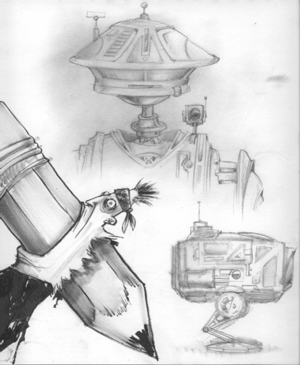
A sketch is a quick freehand drawing, used to capture a fleeting image or reproduce an idea in a brief non-detailed manner. Artists often produce a number of such sketches, before they finally settle on one that they convert to a complete painting. Sketching is then, a sort of artistic brainstorming. The major difference between a sketch and a drawing is the speed with which the former is executed.

Types of Sketchings

There are several mediums that are used for the purpose of sketching. The Renaissance artists made sketches using a silver stylus on specially prepared paper.
Today, sketching is done using graphite pencils, pen and inkcharcoal, crayon, color pencils, inked brushes, pastels and markers.


The graphite pencil comes in various thicknesses and degrees of softness of the graphite. This makes them highly versatile, as they can be used for outlining, shading, filling etc. In the pencil erasing method, the lines that are created are smudged to achieve fullness and various shades. An art gum eraser or hard eraser is generally used. While the former does not completely erase the graphite mark, the latter does.
In the pen and ink technique , the sketch is made using colored ink that is applied via a pen or other stylus. The crow-quill dip pen is used to produce fine lines, while pens with broader nibs produce thicker lines. For technical drawing, the Rotring Rapidograph or Isograph pens are used. Comic book and graphic novel artists prefer using the micron pen. Artists also favour the waterproof Indian ink to the formerly used Iron-gall nut ink, which was a purple-black ink made from tannin and iron salts.
Crayons made of wax, charcoal or chalk are also used for sketching. A crayon made of oiled chalk is called an oil pastel. When it is made of pigment with a dry binder, it is simply a pastel.

Often, artists use markers or marker pens . These are pens which have a tip made of a porous material. A felt-tipped pen is a marker pen with a felt tip.

Silk Paintings

Silk Paintings

A Silk Painting as the name suggests, is the creation of art with silk material as the canvas. This art form requires special skills because the material itself is very delicate and hard to handle.
Silk Paintings are a joyous celebration of both, art and wealth. Silk Paintings have legacies of tradition and rituals of ancient cultures tied with them.

Vietnamese Silk Painting

In Vietnam, painting on silk is popular art form. Vietnamese artists found this technique to be a unique way of lending a mystique charm to their paintings. By using contemporary colors, Vietnamese silk painting has won the hearts of many art lovers. After a long period of development of techniques and styles, silk painting reached its highest period of success during the years 1925-1945. The Vietnamese style of silk painting emphasized softness, elegance and a flexibility of style. These qualities of silk painting were different compared to, at the time, to the dominant French and European oil painting. In 1946, Vietnamese silk painting was accepted and introduced to the world when Vietnamese silk paintings won two prizes at the official Salon organized in France.Silk painting is now popular in Vietnam and has its own unique character and transparency of colors that are different from those of ancient China and Japan.


Indian Silk Painting

In Indian style of Silk Painting, silk is skillfully used as a canvas for portraits and paintings. Traditionally trained and skillful Indian artists make use of a process that allows the silk canvas to "hold" the paint in vibrant details.
Ethnic Motifs and traditional themes are used for Indian Silk Paintings. Silk painting is a very versatile art form-it can be designed as art to hang, functional, such as wearable art or for home decor. The characteristic use of gold in this paintings set it apart form other forms of fabric paintings. The paintings often make use of gold, glitters, gemstones etc.

Rich court life; epics and religious themes are often depicted as a characteristic of silk paintings. Silk paintings have a timeless appeal and their elegance, style and beauty give them a high-status acceptance.

Sand Painting

Sand Painting

Sand Painting is an ancient ritualistic art form, which is sometimes a part of healing ceremonies. Sandpainting is practiced by Native Americans in the Southwestern United States, by Tibetan monks, by Australian Aborigines, and some are known to be made by Latin Americans on certain Christian holy days.
In India Sand Painting is known as Rangoli, and in this art form traditional motifs are drawn in front of homes.

Native American Sand Painting

The Native Americans tribes of Navajos practice the ritual of Sand Painting. The Medicine Man of the tribe paints patterns loosely upon the ground. He lets colored sands flow through his fingers with control and skill and voila - a beautiful sand painting is ready. On some occasions these paintings are made on a buckskin or cloth tarp.


The colors of Native american Sand Painting are usually made with naturally colored sand, crushed gypsum (white), yellow ochre, red sandstone, charcoal, and a mixture of charcoal and gypsum (blue). Brown is made by mixing red and black; red and white make pink. Other coloring agents include corn meal, flower pollen, or powdered roots and bark.
These paintings have great religious significance, and since they are sacred they are made and destroyed within 12 hrs.
The figures depicted in these paintings are Navajo spiritual beings, and they are called yei. These paintings are created to invoke the spirituals beings. The painting ritual is generally accompanied with rhythmic chants of the medicine men.

Pottery Painting

Pottery Painting

A potter's wheel is a common feature in any village in India and the art of Pottery Painting has been a part of the Indian Culture since times immemorial. This rustic craft has a quaint charm, which appeals to the most hardened urbanites.Pottery, in India, is essentially a village craft. Vessels of clay are shaped in a wheel and then baked in furnaces. These vessels are of different shapes and sizes. Each village has a potter community, which is exclusively involved in the art of pottery. 

Blue pottery of Rajasthan

Blue Pottery Painting is an art form of Persia, which was nurtured in India under the patronage of Maharaja Ram Singhji. This art form was first introduced in Rajasthan. This exciting new art form had a fascinating recipe of distinctive ingredients like the ground quartz stone. The color schemes are also very distinctive, blue (oxide of cobalt), Green (oxide of copper) and the white base. 
Some of these pottery are semi- translucent and lately this art form is being experimented with, other colors such as, yellow, dark blue and brown are also used. The conventional floral or calligraphy, hand made patterns and the animal figure patterns are the prominent designs. The various articles shaped out are mostly the traditional ones like surahis or pots of different shapes and size and these articles are used as-ashtrays, tiles, flower pots, lamp shades, jars various accessories or interior items are the forte of this art of pottery.