Paper Painting

Paper Painting

Painting on Paper generally involves the fine art of watercolors. Watercolors involve the mixing of colorants with water and using fine brush strokes on a ground generally made of paper.
Watercolors have the easy understated elegance which most other mediums lack. The ready mixing of water with the pigments gives the paintings a very fluid look. Paper is the ideal base for these paintings because it absorbs the colors very fast and dries very quickly too.


The History of Painting on Paper

With the invention of Paper in Chinain about 100 A.D. a new kind of art came into being, Watercolors, or Painting on Paper with water-soluble pigments. The Chinese used this medium the fullest possible extent and some calligraphies and paintings of this period is still preserved.

By the 12 th Century A.D, watercolors spread to Spain through the Moors. From Spain it spread to neighboring Italy. Italy has some of the worlds oldest paper manufactures.
Watercolors came into wide use during the late 15th century in Great BritainAlbrecth Durer was one of the earliest proponents of this medium. He painted a series of landscape paintings using water-soluble paints on parchment. The use of layers of transparent colors was to represent the dark tones, but for the light colors he used the tone of the paper.
By the 18th Century many artists began to recognize the possibilities of the medium. Many artists have had important roles in the development of this incredible medium but two of the most glittering luminaries are J.M.W. Turner and John Sell Cotman .
Watercolors - the colors

The colors used for paintings on paper are water-soluble pigments. The solidified form of the pigments is called gouache. These gouaches are made of ground pigments mixed with gum for body and glycerin and honey for viscosity. For opacity unpigmented filler is added and oil of clove is added to prevent mold.


Watercolors-the technique

A brush is generally used to apply watercolors. The colors are thinned with water before being applied on paper and water adds transparency to the paintings. This very transparency adds sparkle to these paintings because light passed through the thin film of paint and is reflected back to the viewer's eye.
Though different water-soluble colors are used for Painting on Paper white is traditionally never used, because the white color of the paper is the only white needed for such paintings.
Watercolor paintings need an understanding of colors because it is in its best when the colors blend into each other.
Painting on Paper is just another way of expressing creativity. The only difference is that the medium offers us with the luxury of depicting lights and colors in the subtlest ways.

Palm Leaf Painting


Painting on Paper generally involves the fine art of watercolors. Watercolors involve the mixing of colorants with water and using fine brush strokes on a ground generally made of paper.
Watercolors have the easy understated elegance which most other mediums lack. The ready mixing of water with the pigments gives the paintings a very fluid look. Paper is the ideal base for these paintings because it absorbs the colors very fast and dries very quickly too.


The History of Painting on Paper


With the invention of Paper in Chinain about 100 A.D. a new kind of art came into being, Watercolors, or Painting on Paper with water-soluble pigments. The Chinese used this medium the fullest possible extent and some calligraphies and paintings of this period is still preserved.


Palm Leaf Painting-the technique


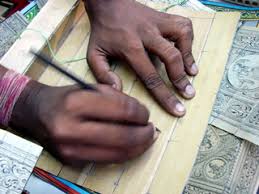
Palm leaf painting or etching involves a few intricate steps:
  • Rows of same sized palm leaves are first arranged together and sewn.
  • These neatly sewn palm leaves are then folded in such a way so as to make a pile.
  • These paintings are first etched out, which means that the designs and images are neatly etched on the surface of the palm leaf using a sharp pen like object.
  • Ink (or a concoction of charcoal of burnt coconut shells, turmeric and oil) is then poured along the lines; the lines are now defined.
  • Vegetable dyes are also added to give these paintings some color, but these paintings are mostly, dichromatic (black and white).
  • The panels of the paintings are unfolded like a fan to reveal a beautiful patta chitra.


Palm Leaf Painting in the modern world


This ancient art form has found admirers far and wide. Not only does the intricate designs and aesthetic depiction of Gods and Goddesses attract ones attention, the use of the leaf adds to the quaint charm of the Art form. This form painting is hailed as very eco friendly too. Today there are small towns exclusively dedicated to this art form in Orissa. One can visit the towns of Raghurajpur and Chitrakarashi to see the artists at work. A first hand sampling of this art form is a must for all art lovers.


Palm Leaf Paintings- the themes


Mythological themes dominate most pattachitras; scenes from the Hindu epics, Ramayanaand Mahabharata are lovingly depicted. Local legends and folklore too find their way into the paintings. Radha and Krishna, Durga, Ganesha and Saraswati are the most commonly used Gods and Goddesses.

In Orissa the legend of Lord Jagannath is used very frequently. In Tamil Nadu, Lord Vishnu is the most popular icon; therefore he is most commonly depicted in the palm leaf paintings.

Oil Pastel

Oil Pastel
Oil Pastel is a painting medium much similar to crayons. They are however different fromsoft pastel sticks which are made with a gum or methyl cellulose binder, oil pastels are made of pigment mixed with a non-drying oil and wax binder. The non drying wax binder makes the surface of oil pastel painting less powdery, but more difficult to protect with a fixative.


History of Oil Pastel

The new education policy of Post World War I Japan led to the invention of Oil Pastel. The Japanese government decided that children of Japan needed a new medium to express their creativity. Oil pastels were an immediate commercial success and other manufacturers were quick to take up the idea, such as Dutch company Talens, who began to produce Panda Pastels in 1930. Yet, none of these can even come close to the prefssionally manufacture oil pastel available in the market today.


Oil Pastel- The Medium

Oil pastels like crayons are used in their dry forms. Light oil pastel strokes produce a crayon like effect. Heavy strokes can create an almost impasto effect. One can apply different oils on the surface of an oil paste painting to create a glitzy effect Alternatively, the drawing surface can be oiled before drawing or the pastel itself can be dipped in oil. More often than not it is the surface on which oil pastels are painted that creates a dramatic effect. Paper is the most popular surface but oil pastels can be used on other surfaces including wood, metal, masonite, canvas and glass. Paper companies make papers specifically for pastels that are suitable for use with oil pastels.

Since oil pastels are a relatively new invention, the effects of dust and light on oil pastel works is not yet known but most specialist agree that this is durable enough to last for generations.


Marble Painting

Marble Painting
Painting on Marble is an Indian phenomenon wherein intricate images are drawn on these naturally beautiful stones. The stone lends a rugged look to the artifacts and the painting medium itself is as exquisite as the paintings. These paintings are of the miniature variety and make for beautiful showpieces.

Miniatures

Delicate brush strokes and great detailing characterize this intricate school of Miniature Painting. Miniature Painters used varied substances for coloring their drawings, namely-minerals, vegetables, precious stones, indigo, conch shells, pure gold andsilver . The Ragas or musical codes of Indian Classical music are beatifically depicted in these paintings. 

Painting on Marble- the history

Painting on marble originated in Rajasthan during the times of the Rajputs. In Rajasthan, marble is most readily available, and is therefore used for various purposes. The Rajputs painters saw marbles as an ideal canvas for their paintings and quickly adopted their style according to the medium.

Minakari on Marble

Minakari is an intricate engraving method where designs are engraved on the marble slab and then painted with specific colors namely red, green, black, yellow, blue. These colors are called mina.

Gold leaf work on Marble

In this style marble paintings are embellished with gold leaves and semi precious stones. The paintings are lacquered after the embellishment to ensure permanence.

Painting on Marble- the technique

Firstly the base is prepared by coating the slab with a neutral color. Sometimes it's “sponged” and responged with colors to get the desired effect. The painter then draws the images with great specificity. Some paintings are then embellished with gold leaves and jewels and lacquered. The painters mainly used vegetable and mineral dyes.

The themes of Marble Painting

The literature of the Bhakti cult (a revolutionary religious cult movement) seems to be the primary source of inspiration for these paintings. The emphasis was on the emotions of love and the view of point was that of a woman's. Radha and Krishna were the models of an ideal couple. These paintings are known for the aesthetic depiction of various love acts of the divine couple.
The exquisite marble paintings with inlay were also done on tabletops, wall hangings, furniture, etc. Today these paintings are a collector's item around the world and are much sought after. Painting on Marble is a versatile art form and is done with or without gold. Marbles of different sizes and thickness are used according to the convenience of both the artist and the buyer.


Ink Painting

Ink Painting
Around 5000 years ago, the ancient Chinese developed ink for blackening the raised surfaces of pictures and texts carved in stone. This early ink was a mixture of soot from pine smoke, lamp oil, and gelatin from animal skins and musk. Other early cultures also developed inks from available berries, plants and minerals.
The growth of Ink Painting has inevitably reflected the changes of time and social conditions.
Following the introduction of Buddhism to China from India during the 1st century A.D. and the consequent carving of grottoes and building of temples, the art of ink painting religious murals gradually gained in prominence

The range of subject matters dealt with in figure painting was extended far beyond religious themes during the Song dynasty (960-1127). Ink Paintings of historical character and stories of everyday life became extremely popular. Techniques were also further refined.
A great many artists painted in this genre during the Song dynasty and their subject matter included a rich variety of flowers, fruits, insects and fish. Many of the scholar painters working with ink and brush used a great economy of line. They produced paintings of such things as plum blossoms, orchids, bamboo, chrysanthemums, pines and cypresses, using their subject matter to reflect their own ideals and character Modern painters have often mixed several colors on one brush or mixed their colors with black inks. As a result, they have obtained more natural and richly varied colors.

Tools of Ink Painting

Following the introduction of Buddhism to In Ink paintings, as in calligraphy, the artist usually grinds their own ink using an ink stick and a grinding stone, but prepared inks are also available. Most ink sticks are made of densely packed charcoal ash from bamboo or pine. The artist puts a few drops of water on the ink stone and grinds the ink stick in a circular motion until a smooth, black ink of the desired concentration is made. Ink sticks are of higher quality and are preferred for works that are to be displayed. Prepared inks are useful for practice.


Modern painters have often mixed several colors on one brush or mixed their colors with black inks. As a result, they have obtained more natural and richly varied colors.

Tools of Ink Painting

Following the introduction of Buddhism to In Ink paintings, as in calligraphy, the artist usually grinds their own ink using an ink stick and a grinding stone, but prepared inks are also available. Most ink sticks are made of densely packed charcoal ash from bamboo or pine. 


Gouache

Gouache
The Italian word “guazzo” means water paint or splash Gouache originates from that very word and is a type of paint consisting of pigment suspended in water. Gouache is quite different from watercolour. In watercolors particles are larger, the ratio of pigment to water is much higher. 

In gouache the presence of an inert white material makes it heavier and more opaque, with greater reflective qualities


History of Gouache

In 16 th century Italy there was a practice of applying oil paint over a tempera base. This particular practice was named Gouache.This particular style travelled to France where it was applied to watermedia.

Gouache-the technique

Gouache is a very deceptive medium. It is drier than it appears when wet, which can make it difficult to achieve the same shading in multiple painting sessions. For this very reason Gouache is seen as a more immediate medium of painting than watercolors. "En plein air” paintings take advantage of this, as do works by J.M.W. Turner. Most painters choose gouache as a medium to dabble with and not m of expression for this very reason there are limited number of works in gouache. It is used more frequently for graphic works such as posters, and for other design work.

Glass Painting

Glass Painting
Painting on glass is a remarkable art form. The beauty of these paintings leaves one dazzled as both the medium and the painting combine to give an ethereal effect.
The medium of glass provides the painter with something that no other mediums can - the light effect. For centuries Gothic churches and other hallowed institutions have inspired awe in us because of their remarkable use of glass paintings. Today it is as popular as it ever was.

A brief History of Glass Painting

It will be difficult to give a precise date of origin of Glass paintings but History says that it became quite a rage in Italy during the Renaissance. They were in the miniature style and where found in altars of churches. They themes were scenes from the Bible

In Austria this Art Form gained more sophistication and slowly it was spread all over Europe, its didn't take much longer for it to reach Asia either. 

Glass Painting in India

Glass painting in India is a comparatively recent phenomenon; it emerged in the state of Gujarat at around 18th century. The Chinese merchants settled around the coastal regions of the state influenced this style of painting. Soon this style was internalized by the artists and was experimented with.
Indian Glass paintings are characterized by their bright colors and ornamental nature. Sometimes they are embellished with gold leaves and semi precious stones. The themes are more or less similar to the miniature Paintings i.e. Radha-Krishna leelas, women dressed in traditional clothes and mythological figures.

Glass Painting- the Technique

Glass paintings or stained glass paintings as they are sometimes known, comprise an engraving laid down on the back of the glass. After the designs are outlined at the back of the glass specials colors are applied. The colors are mostly water or gum based and is applied in a method similar to the way watercolors are applied. The paints are usually fired onto the glass using a kiln. The heat of the kiln ensures that they are permanently bonded with glass.
The medium of glass provides the painter with something that no other mediums can - the light effect. For centuries Gothic churches and other hallowed institutions have inspired awe in us because of their remarkable use of glass paintings. Today it is as popular as it ever was.


Glass Painting in the Modern World

Glass painting is an extremely refined art form but discovery of synthetic colors specially meant for this purpose, has ensured that this art form gains as much popularity as it can. Today almost every other household can afford to have a stained glass window, because of the user-friendly nature of this art form. Art enthusiasts can buy their own glass painting kits and experiment with this art form, making their own bedrooms a studio. This art form is affordable, beautiful and approachable. No wonder that it has become a favorite in the most humble of households. After all the purpose of an artist is to reach out to as many people as he or she can and not to alienate them. Painting on glass is a perfect example of that very philosophy.