Gemstone

Gemstone
Gemstone painting has its origin in Rajasthan, India. Specifically in the historical city of Jaipur.
Rajasthan. The land of color and life. Steeped in history, brimming with music and dance, architecture and art. This is a land that has inspired innumerable craftsmen, and been the object of their imagination since time immemorial. Phad paintings, Miniature painting, Pichwai Paintings, and Gemstone are some of the famous forms of painting from Rajasthan.


The Gemstone painting, as the name suggests, is made of real or semi-precious gemstones. The real stones used include emerald, ruby, blue sapphire, yellow sapphire, multi colored sapphires and pearl. These stones are ground to a fine dust, and placed and pasted on the backside of an acrylic or glass sheet pinhead point by pinhead point. No machinery is used; the work is done entirely by hand. It is then but natural that what is of utmost importance is the skill and precision of the artist. It is the imagination and aesthetic sense that guides the artists in their work, as they carefully bring the themes to life. The result is a painting aglow in the very brilliance of life itself.

The gemstones used in the paintings are all natural, and hence never lose their color. No artificial or dyed stones are used.
It is the art of painting that has captured the life of India, in its many hues and moods. And what more exquisite way to do so, than in the sparkle of a gemstone painting.

Graffiti

Graffiti
A cursory search on Graffiti on the Internet will throw up conflicting opinions such as “A class of rude inscriptions scratched on the walls of ancient monuments”, “ one of the most important mode of expression of the modern world” …so what then is graffiti? Is it a mode of vandalism or is it a misunderstood form of expression? Well one can say its something in between… Graffiti is most definitely a deliberate application of a media made by humans on any surface, both private and public.


Graffiti has existed at least since the days of ancient civilizations such as classical Greece and the Roman Empire. The inscriptions of this order traced by pilgrims, between the fourth and ninth centuries, on the walls of the galleries, proved invaluable to De Rossi and later archaeologists in their explorations of the Roman catacombs.


Nowadays graffiti is synonymous with Hip-Hop and is of the 4 main elements of the Hip Hop culture (along with the MC the DJ and Break Dancing). ?However its definitely a misunderstood art form In fact, modern graffiti is a much older penomenon than the hip hop culture. Its roots are to be found in the late 1960's French Student revolution. The cryptic phrases sprayed on walls were the perfect medium for this revolt. Slogans like “Demand the Impossible” or “Imagination is the seizing Power” inverted conventional logic: they made complex ideas suddenly seem very simple.

In the lates 70s and 80s a a new wave of creativity overtook the graffiti scene. Young intellectuals began actively using grafifiti as a creative medium. Graffiti quickly became a social scene. Friends often form crews of vandals.

Graffiti Tools

Initially pens and markers were used to scribble and doodle on walls, but these instruments were limited in their scope as to what types of surfaces they worked on. So as an alternative was sought in spray-paint. Spray paint could mark all types of surfaces and was quick and easy to use. It didn't take long to make it the chosen medium of application.

As graffiti has grown, so too has its character. What began as an urban lower-income protest, nationally, graffiti now spans all racial and economic groups 

Fresco

Fresco
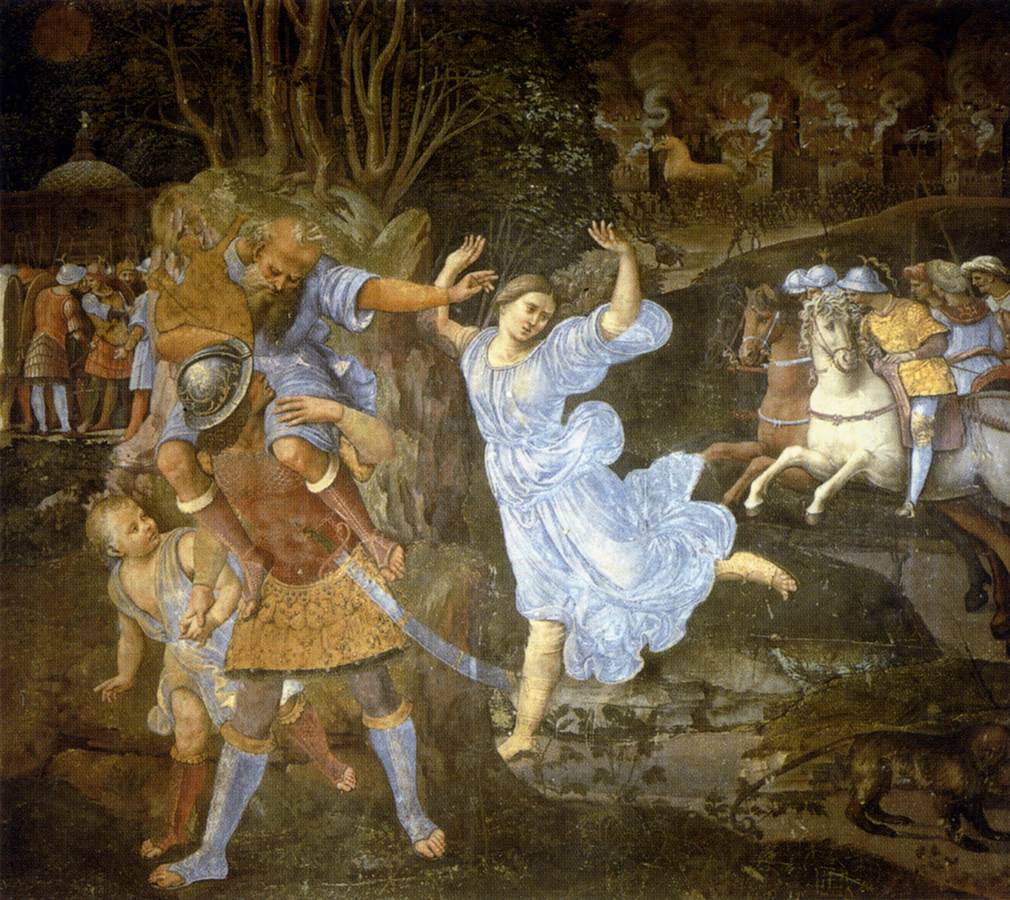
Fresco is a technique where the painting is done when the plaster on the wall is still wet therefore the colors intermingles with the plaster and is permanent.

The Egyptians were the first to experiment with the fresco. The tomb paintings of the Pharaohs in Egypt are the earliest examples of Fresco.

Roman cities such as Pompeii and Herculaneum, witnessed some interesting development in fresco painting too. All wall paintings of these cities were in buon fresco (a technique using wet plaster and pure pigments, the pigments get locked under the calcium carbonate skin of the plaster,creating a long lasting painting).


The desert palace of the Umayyads in the 8th century houses one of the rarest and oldest examples of Islamic frescos.
However fresco came into prominence in the the late Medieval period and the Renaissance saw the most prominent use of fresco, particularly in Italy, where most churches and many government buildings still feature this method of mural painting.
The prehistoric Frescos of Ajanta and Ellora (India) are not only aesthetically pleasing but employ the most ingenious technique too.

Sistine Chapel in Vatican City houses few of the world's most famous frescos, namely those of Michelangelo's.

Fabric Painting


Fabric Painting is not a recent phenomenon, as is commonly believed; in fact the most ancient instance of fabric painting can be dated back to as early as 3000 B.C. Printing blocks belonging to that period has been found in Asia.
Alexander, who invaded India in around 327 B.C, is said to have been mesmerized by the variety and color of theFabric Painting of the region. The development of trade route ensured that this art form traveled to different parts of the world.
China and Japan too were involved in innovations with the technique much before rest of the world discovered it. The Chinese invented the resist and stencil metho d.
Today many other techniques of fabric paintings have been developed around the world; 

batik

tie-dye, and shibori are just some of them.


Batik
Wax and dye combine to produce magic on cloth, and the magic is known as “Batik Painting”. Batik literally mean

“wax writings”

 in Javanese and is believed to have originated in the island of Java, Indonesia, however India too would like to stake claims to what has now become a very Indian art form, moreover it cannot be denied that

Batik painting 

got a new lease of life after its revival in the art schools of Shantiniketan, (Calcutta).

The “wax resist' technique used in this art form makes it both unique and viable. The artistic freedom that the medium offers makes it an approachable art form.

The making of a Batik Painting involves three integral stages-that of waxing, dyeing and dewaxing (removing the wax).

Dyed Fabric Painting

Dyed Fabric Painting

The play of color on fabric, to create unique patterns in enticing shades. Dyed fabric painting is indeed one of the most appealing styles of painting. It is also perhaps the most unpredictable and hence the most versatile, because a large part of the process of painting is not controlled by the artist himself.

He can resist the movement of color, but he cannot control it. What we have, then, is a harmony of hues, with a will of their own.


There are several styles in which fabric may be dyed, and each of these has become and independent type of painting.
  • Batik Painting
  • Tie-Dye Painting
  • Shibori

Tie-Dye Painting

As the name suggests, in the process of tie-dye, portions of the fabric are tied with strings or rubber bands, after it folded in a particular manner. When the fabric is dyed, the protected portions remain uncolored, thus creating beautiful patterns. Some of the most common designs created are the spiral, bulls-eye, striped, ‘V’ shape or a random pattern.

The process of dyeing the fabric may involve dipping the cloth in a tub of dye; in this case, the process is called dip-dyeing. Or the fabric may be dyed by squirting the color, spraying it, or using a brush. In this case, the process is called direct application.

One particular tradition of the tie-dye form of dyed fabric painting, is Shibori.


Shibori is the Japanese form of tie-dye painting. It involves stitching, binding, folding, or compressing the fabric, to resist the dye, and create patterns. In the traditional shibori style, called arashi shibori, a narrow and long kimono cloth is wound around a 12 ft long wooden pole. This cloth is then wound with a thread. When it is scrunched and compressed on the pole, the thread creates creases on the cloth. This cloth is then dyed on the pole, in a large vat. Depending on how tight and how many times the cloth is bound, or the manner in which it is drawn up and puckered, different motifs are created. In kanoko shiburi, the cloth is puckered using the fingertips or nails or a small hook. The other forms of shibori are suji (pleated), nui (stitch resist), miura (looped), kumo (pleated and bound resist).

Charcoal Painting

Charcoal is the blackish residue consisting of impure carbon obtained by removing water from animal and vegetation substances. Charcoal is used in art for drawing making rough sketches in painting, and is one of the possible media for making a parsemage. It must usually be preserved by the application of a fixative.
Artists generally utilize charcoal in three forms:

Vine charcoal

Vine charcoal is created by burning sticks of wood (usually willow or linden/Tilia) into soft, medium, and hard consistencies. Bamboo charcoal is the principal tool in Japanese Sumi-e ( charcoal drawing) art.

Compressed Charcoal

Compressed charcoal is charcoal powder mixed with gum binder compressed into round or square sticks. The amount of binder determines the hardness of the stick. Compressed charcoal is used in charcoal pencils.


Powdered Charcoal

Finely powdered charcoal is often used to "tone" or cover large sections of a drawing surface. Drawing over the toned areas will darken it further, but the artist can also lighten (or completely erase) within the toned area to create lighter tones.

Charcoal and Pencil

The main difference between drawing with a pencil and charcoal is that charcoal leaves a track that is darker, velvety and it can be spread much easier and finer. Both natural and artificial charcoal is used. Natural charcoal is a stick of wooden charcoal with precisely defined characteristics suitable for very fine drawing.

Charcoal Drawing

The drawing starts out by outlining the whole composition. The basic feature of work with charcoal is its ability to spread on the drawing surface and the creation of soft transitions.

Canvas Painting

Canvas Painting
Canvas Painting is probably the most popular and most common form of painting. Canvas is the most suitable medium for Oil Painting.
From Van Gogh to Dali, many painters have achieved magic with the medium…

Canvas

Canvas is a heavy-duty fabric usually made of cotton. It has a simple weave and is ideal as a base of paintings. A gesso coated canvas is stretched across a wooden frame before it is used for paintings. Earlier linen canvas was popular but by the turn of the 19 th centuy cotton canvas gained popularity. However linen is still preffered by professional artists because cooton strtches more than linen.

Most canavases were/are primer coated to make them smoother and easier to paint on.
However most modern painters take advantage of both the canvas texture as well as those of the paint itself. This is stark contrast to the Rennaissance painters who would take great pains not to show the texture.


Oil on Canvas

Most painters will agree that oil on canvas is the best way to paint. Not only is it very user friendly, it' extremely durable too. The colors come out wonderfully well and each brushstroke is visible, and is sometimes accentuated. Modern Painters use the texture of canvas to the best possible effect too.
Some of the best know canvas paintings are as follows
  • Vincent Van Gogh's Starry Night
  • Salvador Dali's Persistence of Memory
  • Picasso's Guernica
  • Van Gogh's Sunflowers